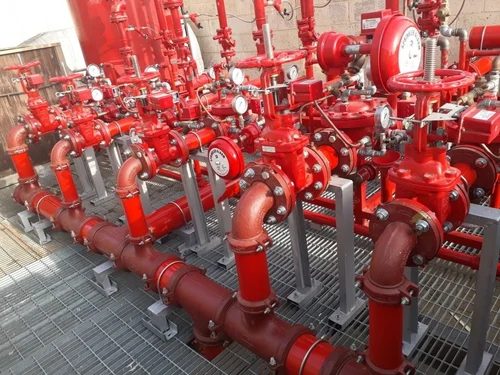
NFPA 13 remains the reference standard most Indian industrial owners and their insurers point to when specifying a sprinkler system, even though the National Building Code and local fire NOC requirements also apply. Getting the design right the first time avoids the two most common and expensive failure modes: an under-protected hazard that fails inspection or insurance audit, and an over-specified system that inflates cost without adding real protection.
Every NFPA 13 design begins with correctly classifying occupancy as light, ordinary (Group 1 or 2) or extra hazard (Group 1 or 2). This single decision drives density and area of application, pipe sizing, and sprinkler spacing — get it wrong and every downstream calculation is wrong too. Warehouses with racked storage, in particular, need separate treatment (NFPA 13 has dedicated storage commodity classifications) rather than being designed as ordinary hazard occupancies by default.
Pipe-schedule sizing is permitted only for small, simple, light-hazard systems. Any facility of meaningful size or hazard level needs a full hydraulic calculation that demonstrates the required density and area of application at the hydraulically most demanding point, accounting for actual available water supply pressure and flow — not assumed values. This is also where an underrated fire pump or an undersized underground main gets caught before installation, not after a failed acceptance test.
A sprinkler system is only as reliable as the water supply behind it. That means confirming municipal supply data or, more commonly in Indian industrial settings, sizing a dedicated fire water storage tank and fire pump (jockey, main electric and diesel standby) to NFPA 20. Final acceptance requires flow tests, main drain tests and a formal contractor's material and test certificate — documentation that insurers and fire departments will ask for later, so it should be planned for from day one rather than assembled retroactively.
Volz designs, supplies, installs and commissions this scope under one contract, engineered to recognized codes and standards for facilities across Pan India, Nepal, Bhutan and Bangladesh.